

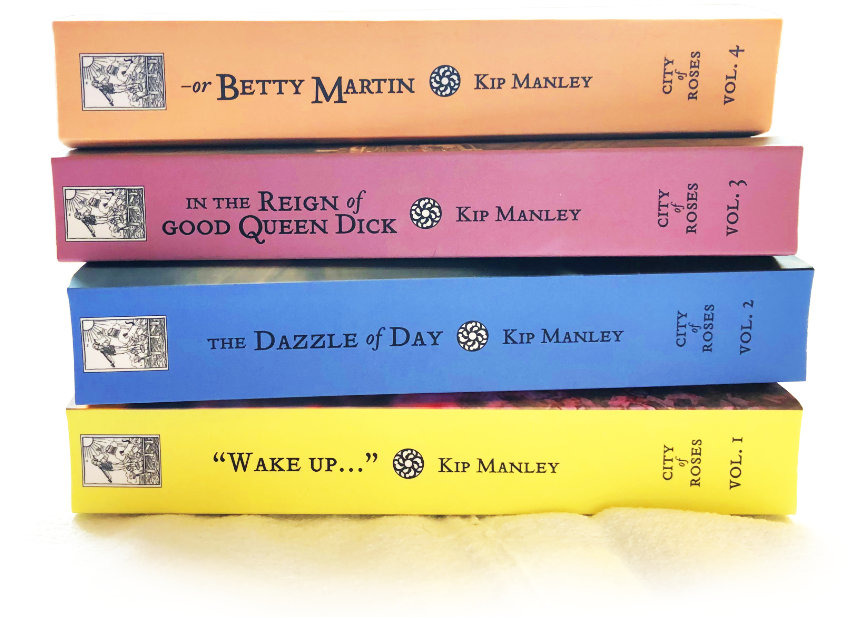
City of Roses is a serialized epic firmly set in Portland, Oregon: a wicked concoction of urban pastoral and incantatory fantastic, where a grocers’ warehouse might become a palace, and an antique bank is hidden beneath a department store.

Sorcerers have always held the anomalous position, at the edge of the fields or woods. They haunt the fringes. They are at the borderline of the village, or between villages. The important thing is their affinity with alliance, with the pact, which gives them a status opposed to that of filiation. The relation with the anomalous is one of alliance. The sorcerer has a relation of alliance with the demon as the power of the anomalous.
Recently, I went to see a Rothko exhibit with my friend Adam. We were in Paris, and the city was gray and cold. On my way to the Fondation Louis Vuitton, I walked through a wooded area. I looked up, and there were pine trees. For a few moments, I couldn’t walk because I was so flattened by the sight of these enormous trees. They were bare of needles. The scaly bark was an ashen purple. The branches were dark as they spread out over the milky veil of the sky. I used to run through pine forests with my cousins. The pine tree is an indelible image of my childhood. But something about seeing them there, when I least expected it, thousands of a miles away from the pine trees of my youth, the trees which had been cut down to pay for booze and which would never be replaced, all this time and distance away from those lost trees, to have encountered them in Paris, my life so radically transformed, startled me.
Happy Labor Day! Today is for me the fourth of a four-day weekend, so I feel I’m doing the holiday justice—though I have been engaged more than usual in the work of self-promotion over the course of it, which is in itself laborious. Ah, well. Let’s get to it:
Her name was Opal. She didn’t become a friend. She was more like a rival. She had flour to the elbow like long white gloves and she clicked that stud while she waited for me to get to the end of a sentence I was in no hurry to get to the end of, because the ordering was the point and the pizza was a formality. “The Pig Kahuna.” Back bacon, thin pineapple, red onion, chopped cilantro, hot honey. I told her how I wanted it built and she built it, layer by layer, with the flat, unhurried patience of a woman dealing cards she knows you can’t afford. The hot honey came last, always last, and she held the bottle at a height that made a thin line of it and I watched the line and she watched me watch it. There are women who will make your food exactly how you asked, and there are women who will make you watch. I ate the slice standing up. I did not taste it once that entire year.
The sun has begun to set, and what’s blue of the sky has achieved a startling cerulean depth, edged by a lace of lavender clouds that float above streaks of gold and amber and virulent orange silhouetted by the horizon, overwhelming the lines and arches of the bridge out across the mouth of the bay, and all those colors also in the placid water, but at a remove, blues edged with purple, dappled with shadows and bronze, the dazzle of it all below, as above, and yet light enough to spare, from the sidelong sun, to read by. “I told her,” says Jo, lowering the unfolded pages in her hand, “next time? Use the mail.”
Out on the deck, under all that color, Sweetloaf’s shadow turns, shoulders slightening, crown of his hair a-waver. “Not a big fucking deal,” he says, through the opened glass door.
“You were followed,” says Jo. “Last time. One of those guys in black suits. Tried to kidnap her last year for some rich assholes. How did you find me?”
“What, it was just the first place I looked,” he’s stepped into the bedroom, details struggling to reveal themselves against the brilliant backlight, “hard to miss this fucking pile.”
“How is she,” says Jo, but then, “who,” she says, lifting the letter, “who is it she’s seeing.”
“Lady?” he says, and she sighs, exasperated, “I know about Marfisa,” she says, “of course I know about Marfisa. This isn’t Marfisa. Who,” she shakes her head, lowering the letter, “she’s turned more, hasn’t she.”
“Lady,” he says, “I’m sure I don’t have the slightest fucking idea, and if I did?” A shrug. “I mean, if herself didn’t fucking tell you.”
“At least she can still do it, I guess?” says Jo, but he’s kneeling there before her, where she’s sat at the foot of the bed, those goggles of his pushed up on his forehead over eyes that brim with concern. “How’s your grace doing, that’s the question.”
“Our reviewers loved the world-building and well-drawn characters.”
“Long, complex with a lyrical rhythm to it that’s intoxicating.”
“Who else could cause an LLM to hallucinate Emma Goldman, John Berryman, and an Irish sea god?”


